
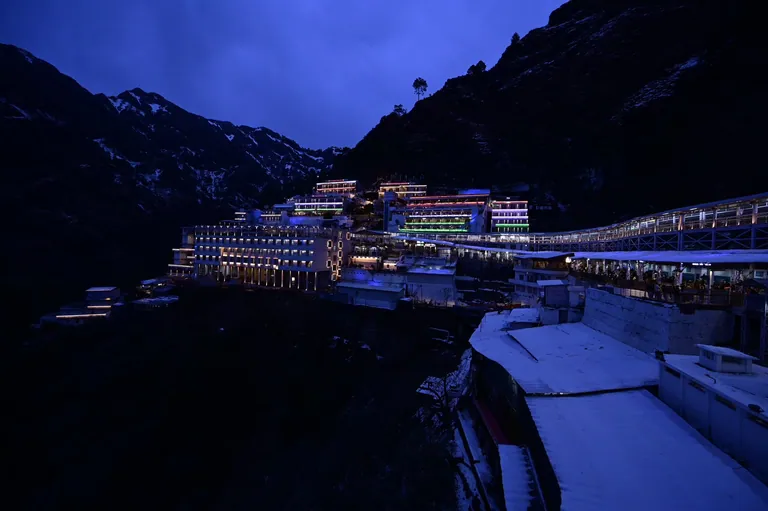
The story of Mata Vaishno Devi is told in several layers: religious tradition and scripture, legends passed down by devotees, recorded history, and the modern administrative history of the shrine since 1986. This page keeps them apart so that you can tell which is which.
Religious tradition
In devotional tradition, Mata Vaishno Devi is a manifestation of the combined energies of Maha Kali, Maha Lakshmi and Maha Saraswati. Her shrine in the Trikuta hills is believed to be her abode, and darshan is of the three Holy Pindis in the cave rather than of any idol.
Several traditions link the shrine with figures from the epics:
- Lord Rama, during his exile, is believed to have met Vaishnavi and directed her towards the cave in Trikoot Parbat.
- The Pandavas are believed to have built the first temples at Kol Kandoli and at the Bhawan. Five stone structures on a mountain adjacent to Trikuta, overlooking the Holy Cave, are believed to be rock symbols of the five Pandavas.
- Prahlad, son of the king Hiranyakashyap, is also believed to have made a pilgrimage here.
- Some traditions regard the shrine as a Shaktipeeth, linking it to the falling of a part of Sati's body; scriptures differ on this. Stone remains of a human hand in the cave are popularly known as the Varad Hast — the hand that grants boons.
The legend of Pandit Sridhar and Bhairon Nath
The most widely told legend concerns Pandit Sridhar, a poor but devout Brahmin of village Hansali, at the foot of Trikuta near present-day Katra.
Inspired by the Goddess, who appeared to him as a young girl, Sridhar organised a bhandara (community feast) for the surrounding villages despite having little to offer. On the day, his small hut miraculously held every guest, and the girl, Vaishnavi, served each guest the food they wished for. Among the guests was Bhairon Nath, a disciple of Guru Gorakhnath, who tested and then pursued her.
According to the legend, Vaishnavi left the feast and went up into the mountains. She is believed to have meditated in a narrow cave at Adhkuwari, now called Garbh Joon, before continuing to the Holy Cave. When Bhairon Nath followed her there, the Goddess took her divine form and struck off his head. Tradition holds that his head fell on a spur of the mountain about one and a half kilometres away — the site of today's Bhairon Temple — while his body remained at the mouth of the cave. The Goddess then remained in meditation in the cave in the form of the Holy Pindis.
Grieving her disappearance, Sridhar prayed until she appeared in a vision, showed him the way to the cave and blessed him. The Shrine Board notes that the various versions agree the shrine was discovered by Pandit Sridhar around 700 years ago. Sridhar is said to have spent the rest of his life in her service at the cave.
Recorded history
Historical records of the shrine before the modern era are limited, and much of what is known comes through tradition.
- The Shrine Board describes the oldest reference to a historical figure visiting the cave as that of Guru Gobind Singh, who is said to have travelled there via Purmandal — the old foot track to the cave passed through that well-known pilgrimage centre.
- For centuries the pilgrimage was made on rough foot tracks, with very basic arrangements for food, water and shelter.
Modern administrative history
| Year | Development |
|---|---|
| 1986 | Management of the shrine taken over by the newly formed Shri Mata Vaishno Devi Shrine Board (Act deemed in force from 30 August 1986). |
| 1988 | Jammu and Kashmir Shri Mata Vaishno Devi Shrine Act, 1988 enacted, vesting administration of the shrine and its endowments in the Board. |
| 1990s | Old track re-laid, widened and tiled; rain shelters, lighting, drinking water points and toilets added along the route. |
| 1999 | Alternate track (via Himkoti) opened — a gentler, wider route on which ponies are not allowed. |
| 2014 | Shri Mata Vaishno Devi Katra railway station opened with the Udhampur–Katra line, bringing trains to the base town. |
| 2018 | Tarakote Marg, a new pedestrian track of about 7 km between Banganga and Adhkuwari, and the Bhawan–Bhairon passenger ropeway inaugurated. |
| 2025 | Katra–Banihal rail section opened on 6 June 2025, linking Katra by rail to the Kashmir valley. |
Formation and role of the Shrine Board
Before 1986 the shrine was managed under earlier hereditary arrangements. The government of Jammu & Kashmir took over its management in August 1986 by setting up the Shrine Board, which was given statutory form by the 1988 Act. The Board consists of a Chairman — the Governor (today the Lieutenant Governor) of Jammu & Kashmir, ex officio — and up to ten members, and works through a Chief Executive Officer. Its jurisdiction runs from the base camp at Katra up to the Holy Cave.
Offerings and donations are reinvested in pilgrim facilities: the Board built and maintains the track, shelters, lighting, water supply and sanitation; runs accommodation at Jammu, Katra and along the route; operates medical facilities including a hospital at Sanjichhat and an ICU at the Bhawan; and has developed institutions such as Shri Mata Vaishno Devi University and a super-speciality hospital near Katra.
Katra's growth as a pilgrimage town
Katra grew from a small settlement into a busy pilgrimage town because it is the starting point of the Yatra. Hotels, dharamshalas, shops and transport services developed around the registration counters, the bus stands and, since 2014, the railway station. The town today serves as the base camp for millions of pilgrims a year. See our guide to Katra.
Frequently asked questions
Who manages the Vaishno Devi shrine?
Shri Mata Vaishno Devi Shrine Board, set up in August 1986 under the Jammu and Kashmir Shri Mata Vaishno Devi Shrine Act, 1988. The Lieutenant Governor of Jammu & Kashmir is its ex-officio Chairman.
What are the three Pindis?
Three natural rock formations in the Holy Cave, revered as Maha Kali, Maha Lakshmi and Maha Saraswati. There are no idols in the cave.
What is the altitude of Vaishno Devi?
The Holy Cave is at about 5,200 ft above sea level. Katra is at about 2,500 ft and Bhairon Ghati at about 6,619 ft.
Timings, fares, rules and routes can change at short notice. Please confirm time-sensitive details with Shri Mata Vaishno Devi Shrine Board or the relevant authority before you travel. Page last reviewed: 4 October 2026.