
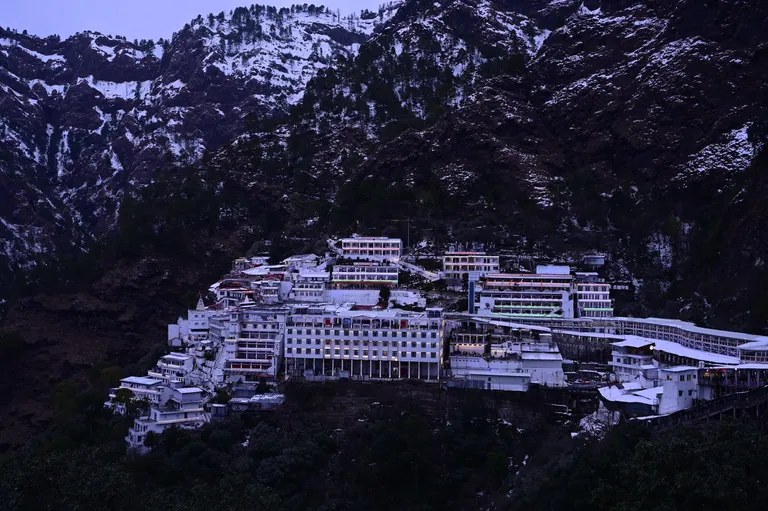
Shri Mata Vaishno Devi is one of the most revered forms of the Mother Goddess in Hinduism. Devotees know her affectionately as Moonh Maangi Muradein Poori Karne Wali Mata — the Mother who fulfils the wishes of her children. Her shrine is a natural cave in the folds of the Trikuta (pronounced Trikoot) mountain, a three-peaked massif above the town of Katra in the Reasi district of Jammu & Kashmir.
Where is the shrine?
The Holy Cave sits at an altitude of about 5,200 ft (roughly 1,585 m) above sea level. Pilgrims reach it on foot or with assistance along a well-built mountain track of about 12–13 km from the base town of Katra, depending on the route taken. The complex around the cave is known simply as the Bhawan.
| Base town | Katra, Reasi district, Jammu & Kashmir |
| Shrine | The Holy Cave, at the Bhawan on Trikuta mountain |
| Altitude | About 5,200 ft |
| Trek | About 12–13 km one way from Katra |
| Nearest railway station | Shri Mata Vaishno Devi Katra (in Katra) |
| Nearest airport | Jammu |
| Managed by | Shri Mata Vaishno Devi Shrine Board (since 1986) |
What do pilgrims see at darshan?
There are no statues or idols in the cave. Darshan is of three natural rock formations called the Holy Pindis, revered as the Goddess in three forms — Maha Kali, Maha Lakshmi and Maha Saraswati. According to the Shrine Board, the three heads rise from a single rock base, just as Trikuta is one mountain with three peaks, and each Pindi differs from the others in colour and texture. Read more about Pindi Darshan and the Holy Cave.
The pilgrimage
A visit to Mata Vaishno Devi is called the Yatra. A typical Yatra looks like this:
- Reach Katra — by train to Katra itself, or via Jammu by air, rail or road. See How to reach Katra.
- Register for the free, mandatory RFID Yatra Access Card. See Yatra registration.
- Climb to the Bhawan via Banganga and Adhkuwari, on foot, by pony or palki, by battery car on part of the route, or by helicopter to Sanjichhat. See the interactive Yatra route.
- Have darshan of the Holy Pindis in the cave.
- Many pilgrims continue to the Bhairon Temple above the Bhawan before returning to Katra.
The pilgrimage draws devotees from across India and abroad. The Shrine Board reports annual numbers in the crores in recent years; its Yatra statistics (opens in a new tab) page publishes the figures month by month.
Who manages the shrine?
Since August 1986 the shrine, its endowments and the Yatra from Katra up to the Holy Cave have been administered by the Shri Mata Vaishno Devi Shrine Board, a statutory body set up under the Jammu and Kashmir Shri Mata Vaishno Devi Shrine Act, 1988. The Lieutenant Governor of Jammu & Kashmir is its ex-officio Chairman. The Board runs registration, accommodation, the track, medical services and the official booking portal. See History for how the shrine and its facilities developed.
Frequently asked questions
Who manages the Vaishno Devi shrine?
Shri Mata Vaishno Devi Shrine Board, set up in August 1986 under the Jammu and Kashmir Shri Mata Vaishno Devi Shrine Act, 1988. The Lieutenant Governor of Jammu & Kashmir is its ex-officio Chairman.
What are the three Pindis?
Three natural rock formations in the Holy Cave, revered as Maha Kali, Maha Lakshmi and Maha Saraswati. There are no idols in the cave.
What is the altitude of Vaishno Devi?
The Holy Cave is at about 5,200 ft above sea level. Katra is at about 2,500 ft and Bhairon Ghati at about 6,619 ft.
Timings, fares, rules and routes can change at short notice. Please confirm time-sensitive details with Shri Mata Vaishno Devi Shrine Board or the relevant authority before you travel. Page last reviewed: 4 October 2026.