
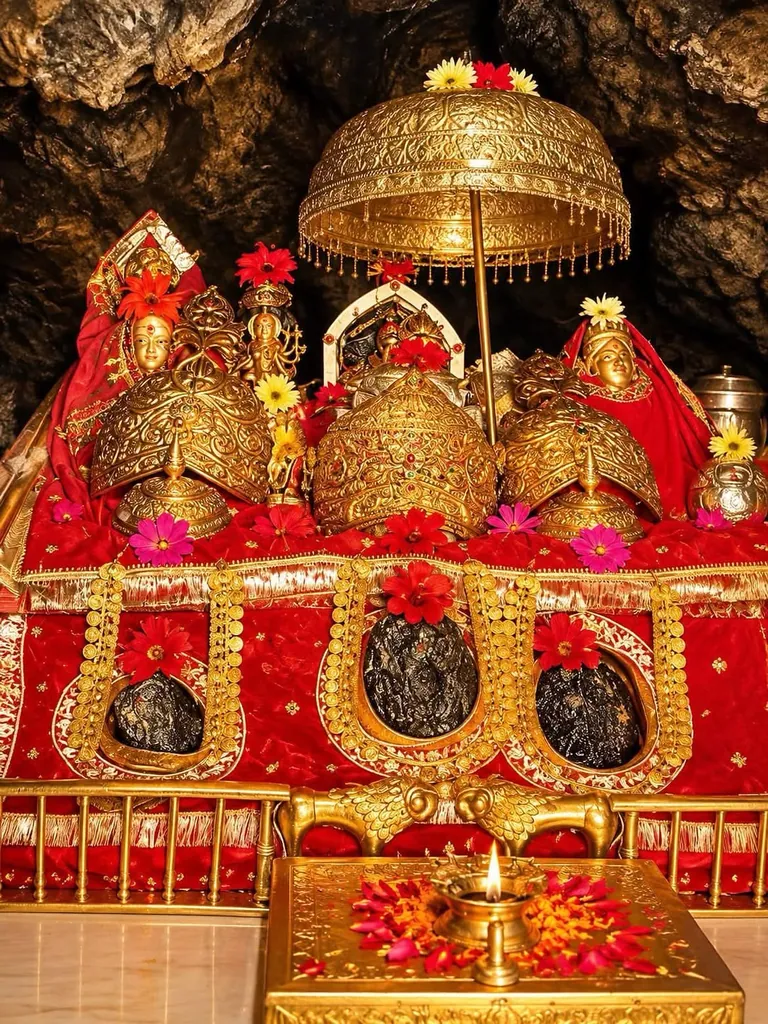
Every Vaishno Devi Yatra leads to one moment: darshan of the Holy Pindis inside the Holy Cave at the Bhawan, about 5,200 ft up the Trikuta mountain.
What are the Holy Pindis?
There are no statues or carved idols in the cave. The Goddess is worshipped as three natural rock formations, the Holy Pindis: three "heads" rising from a single rock body. As the Shrine Board explains, just as Trikuta is one mountain with three peaks, the Pindis emerge from one rock, yet each is distinctly different from the other two in colour and texture. The rock body is immersed in water, and a marble platform has been built around it.
On festive occasions and for aarti, the sanctum is adorned with red chunris, flowers and golden crowns (mukuts) above the Pindis.
The three forms of the Goddess
| Holy Pindi | Form of the Goddess | Associated with |
|---|---|---|
| Maha Kali | The Goddess as destroyer of evil | Strength, protection |
| Maha Lakshmi | The Goddess of prosperity | Wealth, well-being |
| Maha Saraswati | The Goddess of knowledge | Learning, wisdom, the arts |
How Pindi darshan works
- Reach the Bhawan with your RFID Yatra card. See Yatra registration.
- Deposit your belongings. Shoes, belts, combs, mobile phones, cameras and other items not allowed in the Holy Cave go into the free cloak room opposite the main queue complex, or in Sridhar Bhawan. Don't leave cash or valuables in deposited luggage.
- Join the darshan queue. Darshan runs in a continuously moving queue, round the clock. The cave is narrow, so group darshan isn't possible.
- Pass through the cave. A second, artificial tunnel was built beside the original passage to create a one-way circuit, so more devotees can have darshan each day.
- Have darshan of the Pindis. You will have only a few moments in front of the Holy Pindis. Be ready, keep moving and follow the instructions of the staff.
- After darshan, many pilgrims continue to Bhairon Temple.
Aarti at the Holy Cave
The aarti of the Goddess is performed twice a day: in the morning just before sunrise, and in the evening just after sunset. According to the Shrine Board:
- The priests first perform Aatam Pujan (self-purification). The Goddess is then bathed in water, milk, ghee, honey and sugar, dressed in a saree, chola and chunri, and adorned with ornaments, amid the chanting of shlokas and mantras.
- The aarti is performed first inside the sanctum and then outside the cave in the presence of devotees, who meanwhile listen to discourses by the head priest.
- Afterwards, prasad and charanamrit (holy water) are distributed.
- The whole procedure takes nearly two hours, during which darshan remains suspended.
The aarti in the sanctum (Atka Aarti) is relayed live on screens in the Bhawan complex, and cameras inside the cave let waiting pilgrims see the sanctum.
Watch live aarti and darshan
You can watch the aarti and darshan from anywhere through the Shrine Board's official channels:
- Official website: use the "Live Arti/Darshan" button at the top of maavaishnodevi.org (opens in a new tab).
- Official app: Maa Vaishno Devi by the Shrine Board, on Google Play (opens in a new tab) and the App Store (opens in a new tab).
- Official YouTube channel: @Official.SMVDSB (opens in a new tab).
Atka Aarti and Poojan bookings
The Shrine Board offers ways to take part in worship, booked through its official online portal:
- Atka Aarti: attend the aarti performed in front of the Holy Cave, subject to availability.
- Individual Poojan (Havan): a daily havan in the Yagyashala at the Bhawan. In one category the devotee need not be present: the poojan is performed in their name and prasad is sent by courier. In another, the devotee attends in person with up to four family members.
Fees, slots and rules are set by the Shrine Board and change from time to time, so check them on the official portal (opens in a new tab). MataVaishnodevi.com does not take bookings.
Etiquette at darshan
- Keep moving in the queue and follow staff instructions.
- Photography is not permitted inside the cave.
- Dress modestly and keep children close in the queue.
- Avoid the peak periods (summer holidays, the Navratras, New Year) if you want a calmer darshan. See Best time to visit.
Frequently asked questions
What is Pindi darshan?
Darshan of the three Holy Pindis — three natural rock heads rising from a single rock in the Holy Cave, revered as Maha Kali, Maha Lakshmi and Maha Saraswati. There are no idols in the cave.
Can I watch the aarti and darshan live?
Yes. The Shrine Board streams the aarti and darshan through the "Live Arti/Darshan" button on its official website (maavaishnodevi.org), its official Maa Vaishno Devi app and its official YouTube channel. Use only official channels.
How long do I get in front of the Pindis?
Only a few moments. Darshan runs in a continuously moving queue through the narrow cave, round the clock, so be ready and keep moving.
When is darshan closed?
Darshan pauses for nearly two hours during the morning aarti (just before sunrise) and the evening aarti (just after sunset). The Yatra can also be suspended in bad weather.
Can I take photographs of the Pindis?
No. Photography is not permitted inside the Holy Cave. Phones and cameras must be deposited at the free cloak rooms before joining the darshan queue.
Can I book a puja without travelling to Vaishno Devi?
Yes. Under the Shrine Board's individual Poojan scheme, a havan can be performed in your name without you being present, and prasad is sent by courier. Book only on the official portal (online.maavaishnodevi.org).
What is Atka Aarti?
The aarti performed in front of the Holy Cave every morning and evening. Attendance can be booked through the Shrine Board's official portal, subject to availability.
Timings, fares, rules and routes can change at short notice. Please confirm time-sensitive details with Shri Mata Vaishno Devi Shrine Board or the relevant authority before you travel. Page last reviewed: 4 October 2026.